Every few years, someone declares that IPv6 has finally made IPv4 obsolete — and every year, IPv4 leasing volume grows anyway. If you’re evaluating whether to lease more IPv4 space or push your infrastructure toward IPv6 instead, the honest answer is that this isn’t really an either-or decision. It’s a question of what the rest of the internet is actually running today.
What the Difference Actually Is
IPv4 and IPv6 are both addressing systems — the scheme that gives every device on the internet a unique number so traffic knows where to go. The difference that matters practically is size and adoption, not just the technical format.
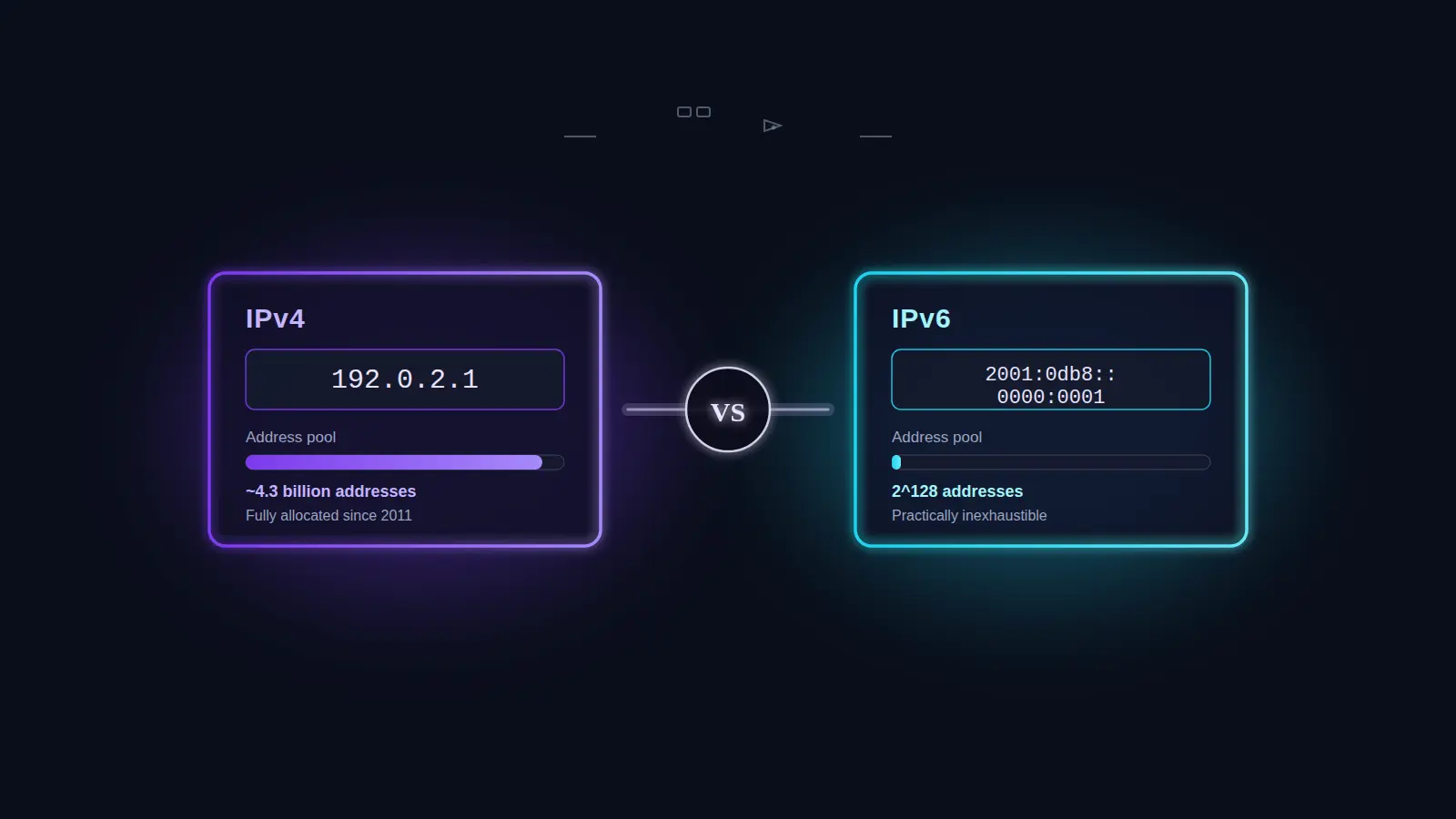
IPv4 addresses look like 192.0.2.1 and come from a pool of about 4.3 billion total addresses — a number that seemed enormous in the 1980s and has been fully allocated by the regional registries for over a decade. IPv6 addresses look like 2001:db8::1 and come from a pool so large (2^128 addresses) that exhaustion isn’t a realistic concern. The tradeoff is that IPv6 adoption, while growing, is still partial — which is the entire reason IPv4 leasing exists as a business.
1. IPv4 Exhaustion Is Real, Not a Marketing Story
All five regional internet registries — ARIN, RIPE, APNIC, LACNIC, and AFRINIC — have exhausted their free IPv4 pools. New IPv4 space isn’t issued from a fresh supply anymore; it moves through transfers and leases from organizations that already hold it. That scarcity is the entire reason a secondary market for leasing and buying IPv4 addresses exists at all.
Mobosoft insight: Every block we lease comes from our own existing ARIN and RIPE allocations — not a resold or brokered third-party block — which is why we can issue LOA, ROA, and IRR route objects within one business day instead of routing a transfer through someone else’s approval process.
2. IPv6 Adoption Is Growing, But It Isn’t Universal
Google’s own IPv6 adoption statistics show meaningful growth over the past decade, but a large share of enterprise networks, legacy systems, ISPs, and specific regions still run IPv4-only infrastructure, or a dual-stack setup that depends on IPv4 for compatibility. Full replacement isn’t close, and for many networks it isn’t the goal at all.
The practical result: if your customers, partners, or infrastructure providers aren’t fully on IPv6, you need IPv4 reachability regardless of your own preference.
3. Cloud Providers Still Charge for IPv4 — Which Is Reviving Demand for Leasing
Public cloud providers now bill separately for public IPv4 addresses (AWS, for example, charges per address per hour), while IPv6 addresses typically carry no such charge. That pricing shift has pushed some workloads toward IPv6-only where possible — but for anything that still needs public IPv4 reachability, it has made owning or leasing your own IPv4 block (and bringing it in via BYOIP) more attractive than paying the cloud provider’s per-address rate indefinitely.
Mobosoft insight: We support BYOIP into AWS, GCP, and Azure on every block we lease, handling the RPKI/ROA setup so the cloud provider accepts the announcement — most providers require a /24 minimum, which lines up with our smallest available block size.
4. IPv6-Only Isn’t an Option for Most Businesses Yet
Running IPv6-only infrastructure sounds appealing until you account for every legacy client, partner API, monitoring tool, and piece of infrastructure that still expects an IPv4 address. Dual-stack — running both — is the realistic middle ground most networks operate in today, and dual-stack still requires holding IPv4 space.
5. Leasing IPv4 Is Now the Practical Way to Get It
Since new IPv4 allocations aren’t coming from the registries directly, businesses that need more IPv4 space get it one of two ways: buying a block outright (a five- or six-figure capital purchase for anything meaningful), or leasing it as an operating expense. Leasing has become the default route for anyone who needs the address space without wanting to tie up capital in an asset whose long-term value is genuinely uncertain as IPv6 adoption continues to grow.
Mobosoft insight: Our lease pricing is flat and published — $0.50 per IP per month, available on month-to-month, 6-month, or 12-month terms — specifically so a business can scale its IPv4 footprint up or down without a long-term commitment tied to where IPv6 adoption ends up in a few years.
The Bottom Line for Growing Networks
IPv6 isn’t replacing IPv4 anytime soon, and pretending otherwise doesn’t make your infrastructure’s IPv4 dependency go away. For most businesses, the practical move is dual-stack support — and since new IPv4 space only comes from the secondary market now, leasing is the fastest, lowest-commitment way to get it.
Need IPv4 Space That’s Ready to Route Today?
Mobosoft leases IPv4 blocks from our own ARIN and RIPE allocations, with published pricing and LOA/ROA/IRR issued within one business day.