If you have ever leased or purchased IP address space, you have probably seen the term “ASN” attached to the paperwork — and if you have never touched network administration directly, it is easy to nod along without knowing what it actually does. An ASN is not optional paperwork. It is the number that tells the rest of the internet who is responsible for a block of addresses, and whether you need one of your own depends entirely on how you plan to use the space.
What an ASN Actually Is
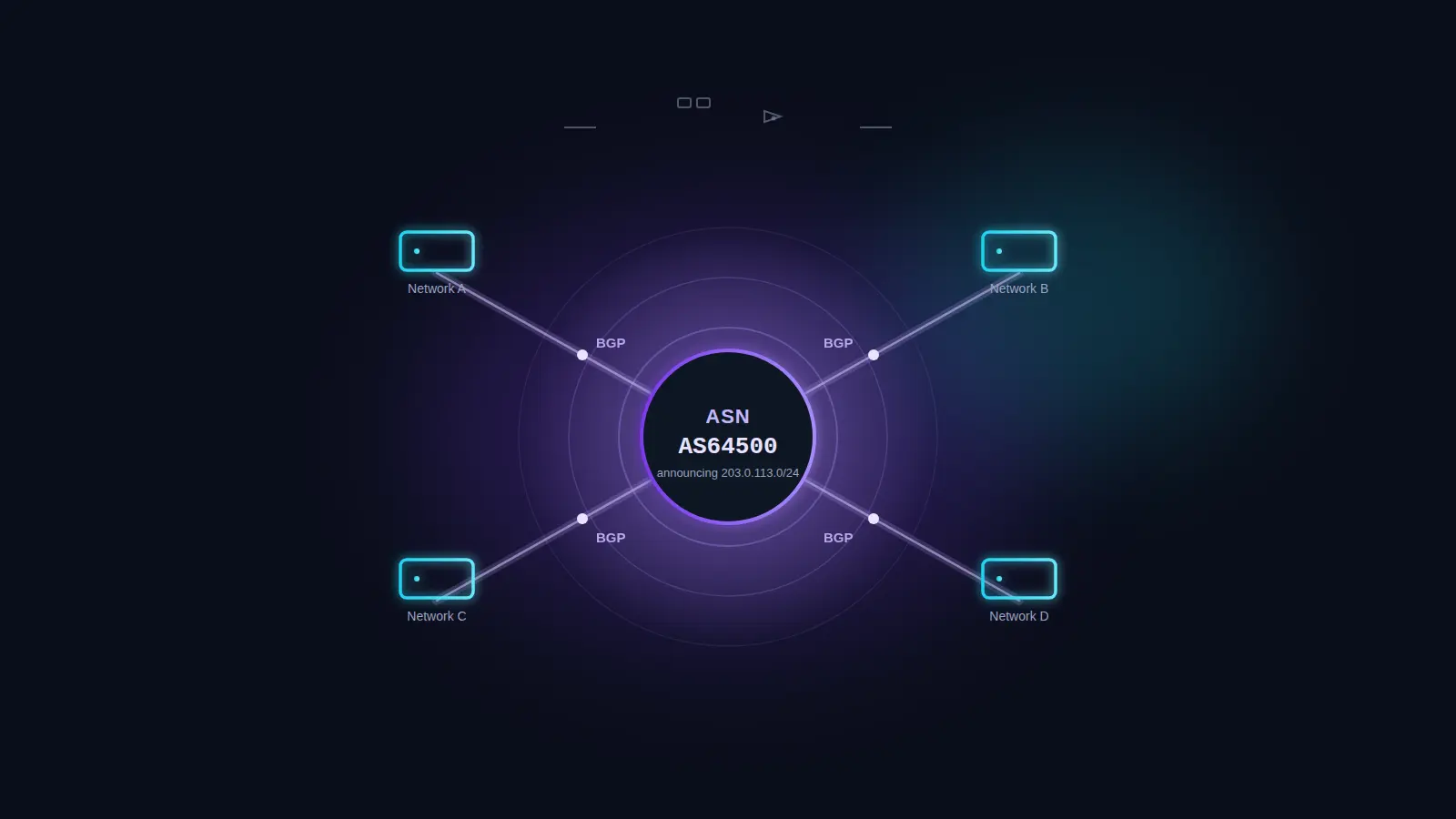
ASN stands for Autonomous System Number. Think of the internet as a network of networks — each ISP, cloud provider, hosting company, and large enterprise runs its own independently managed network, called an “autonomous system.” An ASN is the unique ID that identifies one of those networks when it announces routes to the rest of the internet via BGP (Border Gateway Protocol).
It is closer to a business’s tax ID than a phone number: it does not route traffic by itself, but it is the identifier every registry and every other network uses to know exactly who is announcing a given IP block, and who to hold accountable if something goes wrong with it.
1. An ASN Is What Lets You “Announce” IP Space
Owning or leasing an IP block does not automatically make it reachable on the internet. Somebody has to announce that block via BGP, telling every other network “traffic for these addresses comes through me.” That announcement happens under an ASN.
If you already run your own network — a hosting company, an ISP, a company operating its own data center presence — you likely already have an ASN, and you announce leased or owned blocks under it directly.
Mobosoft insight: Every lease we issue ships with a signed LOA plus a published ROA and IRR route object, so a customer with their own ASN can start announcing the block correctly the same day the paperwork clears.
2. You Don’t Need to Register One to Lease IPv4 Space
This is the part that surprises people evaluating IPv4 leasing for the first time: getting your own ASN is a real registry process (an ARIN or RIPE membership, annual fees, justification of need), and it is simply unnecessary if you just need a block of addresses announced on your behalf.
A leasing provider that already holds ASN infrastructure can announce the block for you, under their ASN, while you use the addresses. You get a working, routed IP block without ever touching ARIN’s or RIPE’s ASN application process.
Mobosoft insight: This is exactly why our quote form has a single checkbox — “I don’t have an ASN, I need this block announced for me” — instead of a multi-step application. Most customers who don’t already run their own network use it.
3. Having Your Own ASN Matters More as You Scale
There is a real point where getting your own ASN starts to make sense: once you are running enough infrastructure that you want direct control over routing decisions, multi-homing to more than one upstream provider, or building out your own network footprint independent of any single provider.
Below that threshold, an ASN is administrative overhead. Above it, it is closer to a requirement — you cannot multi-home properly or run true BGP redundancy without one.
Mobosoft insight: We see this shift most often with hosting providers and regional ISPs who started with a single leased block and grew into needing their own ASN once they added a second upstream connection — at that point, our Managed IP & Network Services team handles the ASN and RPKI setup rather than the customer building it from scratch.
4. Your ASN’s Reputation Follows the Number, Not Just the Address Block
Just like an IP block, an ASN accumulates a reputation over time based on what gets announced under it — spam complaints, abuse reports, route leaks. A clean ASN with a documented history is worth protecting; a dormant or newly registered one carries no track record either way, which some networks treat cautiously by default.
This is one more reason smaller operators are often better served leasing under an established provider’s ASN rather than standing up a brand-new one with no history.
The Bottom Line for Growing Networks
You don’t need your own ASN to lease and announce IPv4 space — you only need one once you are ready to control your own routing directly, typically once you are multi-homed or running independent network infrastructure. Until then, leasing a block under a provider’s existing ASN gets you routed, working IP space without the registry overhead.
Ready to Get IP Space Announced — With or Without Your Own ASN?
Mobosoft leases IPv4 blocks under our own ARIN and RIPE allocations, with LOA, ROA, and IRR route objects issued within one business day — whether you’re announcing under your own ASN or need us to handle it for you.